History of 1648
1648 stands out as one of the most important years in European and world history. The Thirty Years and Eighty Years Wars particularly benefited France. While the former ostensibly concerned religious freedoms, Catholic France mostly backed Protestant interests. This gives us a notion of some the intrigue in play as Louis XIV came of age. This geopolitical play was unpopular and led to a dual uprising called The Fronde. That episode significantly set the foundation for most Louis XIV's reign. France was also in the midst the Franco-Spanish War of 1635-1659.
Why a blog, of all things, of the year 1648? What relevance does a 378 years in the past have to do with 2026? Turning points are turning points and history is dynamic. The year 1648 featured a clear shift toward modernism, in the historical sense. And that's just the mainstream historical part. The synodic cycle turning points of that year and the surrounding decade themselves stand out as turning points that are rare and especially noteworthy.
Before and After
We see a stark characteristic of 1648 in a clear before and after division. Perhaps more than previous Neptune-Pluto cycles, the comparison of the two sides displays change we can call exponential. Population, industrialism and resource exploitation expanded in unprecedented ways that continue into the current cycle.
A Unique Outer Planet Cycle Repetition
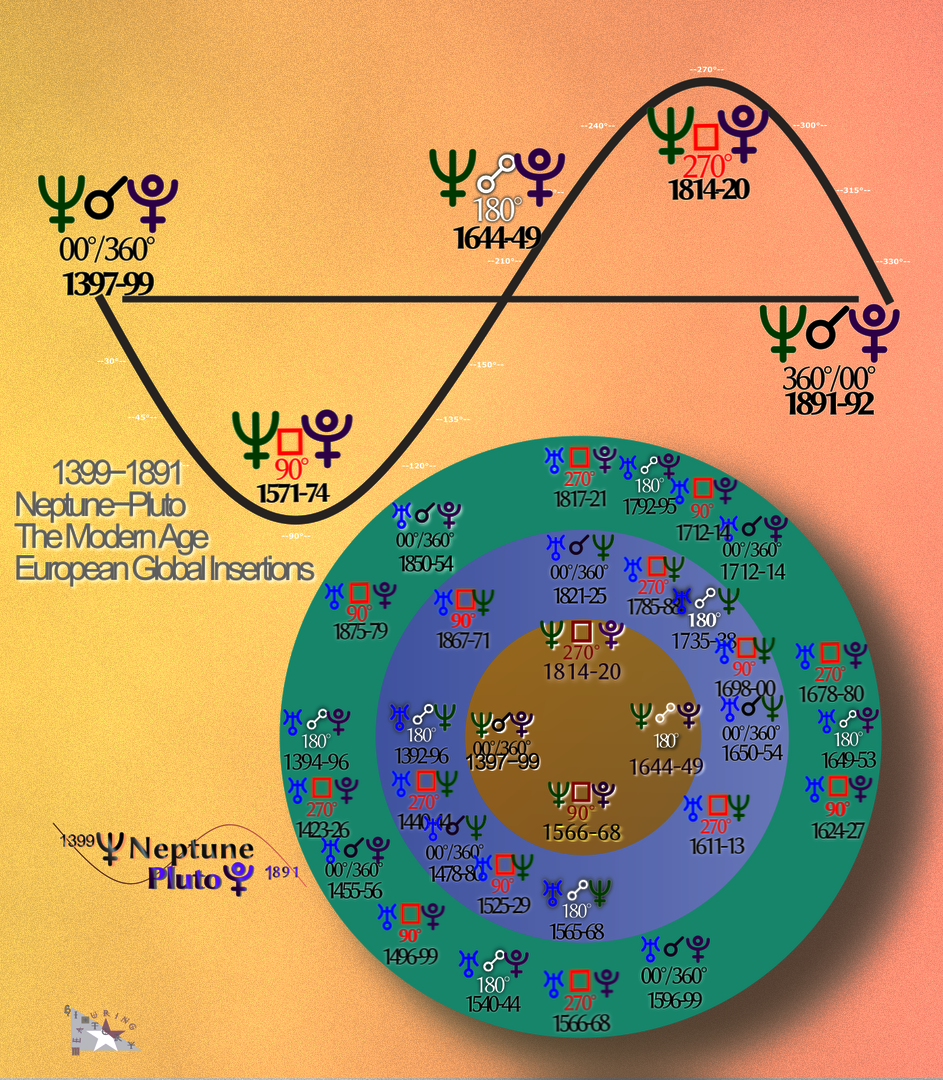
The outer planet pattern 1648 belongs to has unique properties seen rarely across Neptune-Pluto cycles: the coincident alignment of Uranus-Neptune and Uranus-Pluto cycles to Neptune-Pluto's. We can only know this pattern by comparing this cycle to others. Of the six Neptune-Pluto cycles from 576bce through now, only the 576bce-83bce and 1399-1891 cycles share this pattern; there was also one that began the 3065bce-2553bce Neptune-Pluto cycle, which emerged about the same time as the Bronze Age
How We Got to Where We Are
History helps tell us how the world we inherit formed. There are probably more ways to read history than histories themselves. 1648 reads how the world moved from an almost completely regional, agrarian approach to one where industry left little of our planet undiscovered or open to exploitation. Perhaps at the top of the surprise list, the distinction between previous mindsets and the post 1648 is quite discernible. As we move closer to our time in our survey, the more we resemblance to our time. In many ways, though 1648 stands at the midpoint of the 1399-1891 Neptune-Pluto, it also represents a distinct starting point.
People Make History
History means little without the people who create it. Characters such as Descartes and Galileo feature heavily throughout 1648. Luckily for us, we are able to glean accurate birth dates and even some exact times as the tale gets closer to the modern age. Louis XIV, Quen Victoria, Darwin and others we examine via horoscopes relevant to their relevant outer planet cycles. I can state with strong confidence that this history is something mainstream sources omit. Readers will see a unique dimension of how personal history transects with the general kind.
History is History
That 1648 deploys outer planet synodic patterns to read history enhances history rather than change it in any manner. In the briefest terms, 1648 covers the history of birth of modernism. That the events surrounding 1648 are fundamental to how the world moved from the Middle Ages to the Modern World and our extension into the Anthropocene Era. History is history but measuring history is holistic. 1648, the year is still holds a strong presence in our lives.